
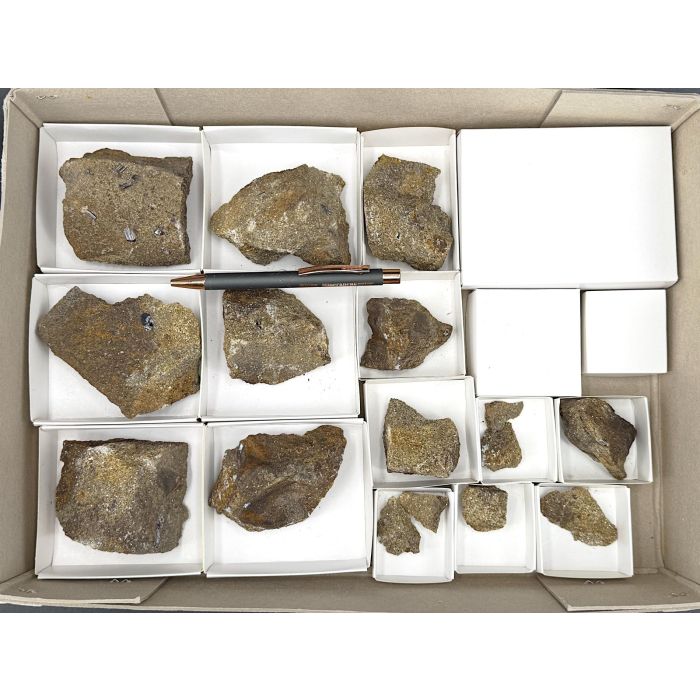
Rutile crystals and embedded crystals from Brazil. One lot with 14 pieces, unique piece.
This lot comprises 14 specimens containing exposed, embedded and partly developed Rutile crystals from Brazil. The dark brown to black metallic crystals stand out clearly against the lighter fine-grained matrix, creating an attractive mineralogical contrast. Several specimens display well-developed prismatic crystals, while others contain embedded or only partially exposed crystal sections.
Rutile is one of the most important titanium minerals and is highly appreciated by collectors for its distinctive crystal habit and metallic lustre. The lot offers a varied selection of Brazilian Rutile specimens with different crystal developments and matrix characteristics, making it suitable for collectors as well as educational and display purposes.
Geology & Origin
Rutile (TiO₂) forms in a variety of geological environments, particularly in metamorphic rocks and hydrothermal deposits. Brazil has long been one of the world's most important sources of well-developed Rutile crystals. These deposits regularly produce specimens with clearly developed crystals that are of both scientific and collector interest. Typical features include the prismatic crystal habit, dark metallic lustre, and high titanium content.
Abbreviations commonly used in mineralogy.
| Abbreviation | Meaning |
| xl | single crystal, possible with matrix |
| xls | noticeable crystals |
| (xl) | embedded or damaged |
| (xls) | embedded or damaged |
| MASS | massive and/or amorphous pieces |
| TYP | type locality of the original description |
| SWUV | shortwave-UV-reaction |
| UV | ultraviolet reaction |
| SC | self-collected |
| U | unique (single unique piece) |