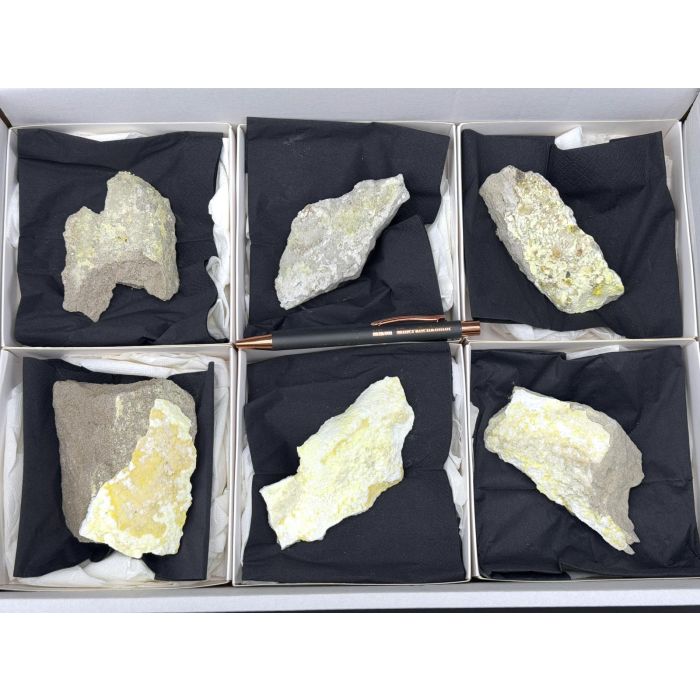
This flat contains Andersonite and Zippeite from the D-Day Mine in Utah (USA), with several areas showing strong UV activity. The specimens display a vivid combination of bright yellow tones, white crusts, and subtle greenish shades forming fine-grained to compact coatings across the matrix. Under UV light, these uranium-bearing minerals fluoresce in intense yellow to green hues, highlighting the richly textured surfaces. The six individual pieces together form a varied and visually striking selection from this classic locality.
Geology & Origin
The D-Day Mine in the Canyonlands region of Utah is one of the notable localities for secondary uranium minerals formed within strongly oxidized sandstone environments. Andersonite develops through reactions between sodium-rich fluids and uranium-bearing residues, while Zippeite forms as a sulfate-rich hydrate within the same oxidation zones. The typical paragenesis of both minerals is clearly expressed in this flat, showing strong coloration and fluorescence that reflect the characteristic formation conditions of the area.