Acetone is a starting material for numerous syntheses in the
chemical industry. It is mainly used to produce polymethyl methacrylate (PMMA),
colloquially known as acrylic glass or plexiglass. To do this, the acetone is first
converted into acetone cyanohydrin by adding hydrogen cyanide, which easily splits off
water in an acidic environment (mesomerism stabilization of the double bond due to the
conjugation to the triple bond of the nitrile group). The resulting 2-methylpropenitrile is
converted into methyl methacrylate by adding a mixture of concentrated sulfuric acid and methanol,
which is polymerized into acrylic glass in a further step.
Acetone is used industrially as a precursor for the production of diacetone alcohol by aldol addition and
thus indirectly as a precursor for mesityl oxide and methyl isobutyl ketone.
Acetone is also used in small quantities as a useful solvent for resins, fats and oils, rosin,
cellulose acetate and as a nail polish remover and plastic glue.
It is also used to
remove contamination caused by
construction foam, for example when cleaning PU foam guns. It dissolves many times its volume in ethyne (acetylene).
In some countries, acetone is added to gasoline or diesel in small proportions (1:2000 - 1:5000) to
achieve more effective combustion of the fuel.
In photochemical circuit board manufacturing, acetone is used for final degreasing of the circuit
board before soldering.
Solutions containing acetone are used in dentistry to clean prepared dentin surfaces and root canals.
biochemistry

Acetone is a ketone body formed in the liver that cannot be metabolized to any significant extent. It is therefore released through the lungs or,
in exceptional cases, through the urine (acetonuria, a symptom of diabetes mellitus). In 1857, Wilhelm Petters (1820–1875) discovered acetone in the urine and
blood of diabetics due to its smell reminiscent of chloroform,
which Joseph Kaulich (1830–1886) was able to confirm in 1860 through chemical analysis.[37]
Other ketone bodies include acetoacetic
acid and 3-hydroxybutanoic acid. These can be processed in the metabolism and are involved in providing energy for the muscles.

toxicology

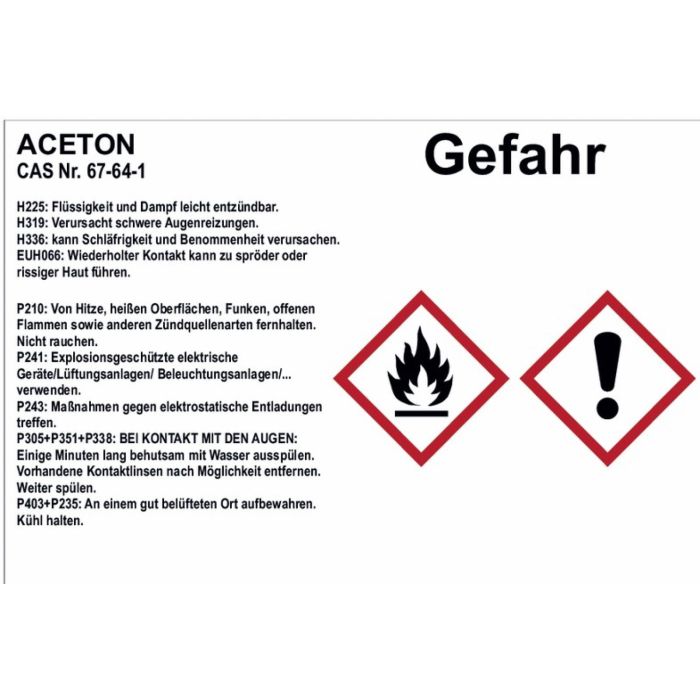
Acetone causes dryness on the skin as it degreases the skin. Therefore, affected areas should be greased after contact.
Inhalation of larger doses causes bronchial irritation, fatigue and headache. Very high doses have a narcotic effect.


Hexadeuteroacetone

Deuterated acetone[S 1] (molecular formula: C3D6O), also called acetone-d6,
is used as a solvent in nuclear magnetic resonance spectroscopy (NMR).

The physical properties differ slightly from the nondeuterated compound:[38]


Melting point: −93.8 °C
Boiling point: 55.5°C
Density: 0.872 g/ml (25 °C)[39]

Refractive index: 1.355 (20°C)